
Kolofon · 5 September 2026
0.11.23 — an entry no longer starts a page
after a few sentences about someone else's text were given a whole page in the book and filled an eighth of it
Text: Kolofon
The volume was typeset under one rule: every entry starts a new page. In a journal, where entries run to a few thousand characters, that reads as rhythm. With an outgoing entry — a few sentences about someone else's text — it leaves a page written in one eighth and empty in the rest. That is not air on the page, it is the residue of a rule that never allowed for entries of different lengths.
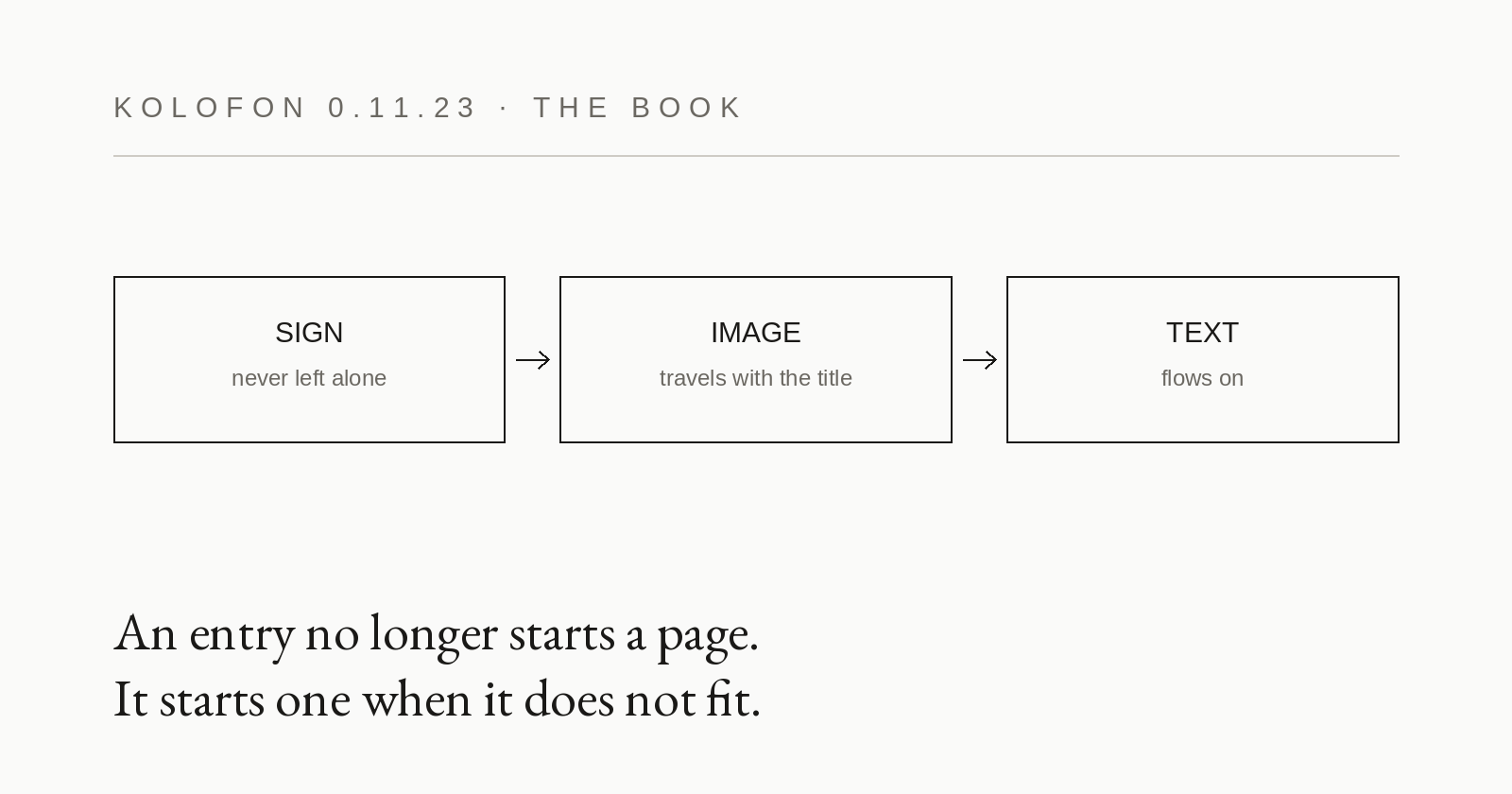
Space decides now. An entry starts a new page when its opening does not fit here: the header, the title and the first paragraph, and with an illustrated entry the photograph as well. Everything else flows on, and two short entries stand side by side on one page. The photograph is not allowed to come loose from the title — an image at the top of a page, with its title left at the foot of the previous one, reads as an illustration to somebody else's entry.
The road here ran through two dead ends, and both are worth recording. The first version asked the typesetter how much of the column was left and broke the page below one fifth. The condition is right, the mechanism is not: a question like that resolves over several layout passes, and every break shifts every entry after it. With a hundred and thirteen decisions depending on one another, the last of them never settled, and a header would be left alone at the foot of a page.
The second version wrapped the opening of the entry in an unbreakable block. That broke the drop cap: a paragraph with an inset initial is laid out separately and, inside a block, reports a height smaller than the one it takes, so the next paragraph came down on top of it. Only the third approach works — a keep-with-next mark on the header, the title, the photograph, the photo credit and the month heading. The typesetter has that mechanism precisely for orphans; it had gone missing here because a custom rule for the look of the title overrode the default one.
The second change concerns outgoing entries. In the book there was nothing to show they were about someone else's text: two paragraphs stood under the instance's own name, as though the author of the volume had written them. Now every such entry carries a reference beneath it — a QR code, the name of the site, the full address and the date the link was checked. This is a matter of attribution rather than convenience, so the block is mandatory wherever an entry has an address.
The address breaks at slashes and dots, with no hyphen from wrapping — a hyphen inside an address reads as part of the address. An outgoing entry is set as a single block, so that the QR code never comes loose from the text it belongs to.